Up next in 10



One of the main ways orchids communicate what is happening to them is through the color change. Their leaves, roots, stems, and flower spikes can all change colors, displaying the most varied differences in what should be normal.
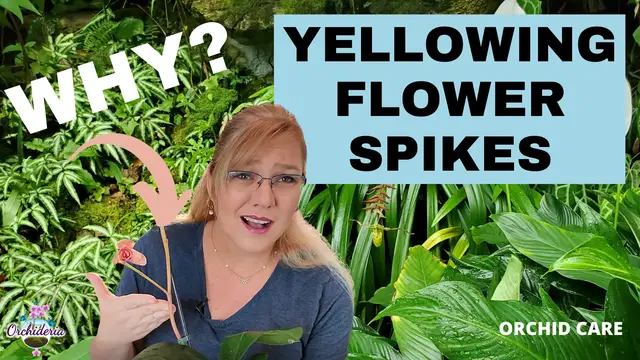
If an orchid produces a flower spike and it turns into a pale yellow, either the potting medium and environment are too dry, it is suffering from nutrient deficiency, an extreme change in temperature suddenly affected the blossoms, high concentrations of elements in the water supply, presence of ethylene gas in the environment, and it might indicate a normal decaying process.
Show More Show Less View Video Transcript
0:00
This orchid only has one little blossom left and it's time to repot this orchid and I was
0:05
about to cut the spike when I realized this orchid spike isn't ready to cut right yet
0:12
Now how do I know that? Well I'm going to show you in this video
0:20
Hi I'm Amanda Matthews and thank you for watching this video at Orchidaria
0:24
So there are seven main reasons that your orchid spike will turn yellow
0:29
Now before I go into each one of these, I want to really express one thing
0:34
The orchid spike turning yellow is different than the orchid stem turning yellow
0:40
So the stem is the main central part of your orchid. If that turns yellow, you have a major problem which is probably caused by overwatering or
0:50
it's caused by bacteria or fungus. So you really need to check that out and that is extremely hard to cure
0:57
What I'm talking about in this video is strictly the spike or the inflorescence where the flowers or the blossoms are on your orchid
1:05
If this part is turning yellow, that's what this video is. So if your problem is the spike, I'd skip to a different video
1:14
Okay, now that that's out of the way, let's get to the seven reasons that the orchid spike might be turning yellow
1:20
The first reason is there's not enough humidity in the air for it to maintain a strong healthy spike so it starts to turn yellow
1:31
Now let's think back. Most orchids live in a higher humidity than what we have growing indoors
1:38
And if you're new to my channel, I teach you how to grow orchids indoors. Now some people grow orchids outside and that's great, that's wonderful, except in my conditions I can't do that
1:48
and actually that was a good thing a positive thing because that's where I learned how to grow
1:53
orchids you know before when I lived overseas I could just put them on a tree and yeah they're
1:58
they're there I didn't have to do anything but now that they're inside and my outside conditions are
2:05
not good for orchid care I had to learn how to do this indoors and that's where I really
2:11
really dived into orchid care. So now that you know. So the first one is not enough humidity
2:20
So inside this is my home office and here my humidity is around 33 percent. It's a constant
2:28
33 percent because during the day I have the air conditioner on or the heater on either one or the
2:33
There's never a nice day. That's not what I meant. What I meant was that the temperature is really hard
2:42
to keep constant without some kind of external device. So both the air conditioner and the central heating unit will absorb that humidity and just suck it out of the environment So it also sucking it out of your flower spike and flower spikes need to be
3:00
extremely hydrated, which will go into point number two. But the outside moisture to create
3:09
that balance is going to suck the humidity out of the flower spike. And since the flower spike is
3:15
the newest part of the orchid is the most tender part of the orchid. It's easier to suck it out of
3:21
that than to suck it out of the leaves. So your orchid is going to feel it a lot more. Your blossoms
3:28
are either not forming well or they're yellowing before they form. It could be the lack of humidity
3:36
You need to raise that. Now, Phalaenopsis will like a humidity of around 40, 50
3:44
Some like it even higher than that. It will depend on the type of genus of your orchid
3:50
The second reason is it's not getting enough water. To form these blossoms, they have to use a lot of energy
3:57
So all this energy is being moved around through the Shilam in the orchid cells to produce these
4:04
buds to make them beautiful and open up and stay open because that's the whole point of the orchid
4:10
It wants to reproduce and get more little orchid seeds out there. So all the water and nutrients
4:17
are traveling constantly up through the stem and back down to the roots and just moving these
4:23
nutrients all the way up. If there's not enough water, either you're not watering frequently or
4:30
you're not using enough water then your orchid spike will turn yellow so if you notice that your
4:37
buds are shriveled you know it's not that they're blasting but they're very shriveled and they open
4:44
up they're not to their full potential it's probably because there's not enough water just
4:50
moving through the shilom which is the internal structures of the it's kind of like the
4:57
what's that called? Anyway, so yes, your orchid can get dehydrated. So increase the levels of watering, especially when
5:12
it is starting to push out that new flower spike. You notice those new flower spikes
5:18
your orchid is consuming a tremendous amount of energy. So it really needs a little bit more water
5:25
or maybe a little bit more frequent. That will depend on your potting media
5:30
The third reason could be a nutrient deficiency. Now there are several nutrients
5:36
that will turn these spike yellow. The main nutrient deficiency that will turn your orchid spike yellow are potassium magnesium zinc nitrogen and iron If you haven been fertilizing a little bit once a week while you water
5:53
you need to really start adding that to your daily routine in orchid care
5:58
The fourth reason that your orchid spike might turn yellow is a temperature drop
6:03
And I'm talking about an extreme temperature drop. Let's say you went to an orchid nursery and you bought this orchid
6:09
and inside the nursery it's all nice and cozy and you bought it in winter and walked out and carried
6:15
this to your car. The buds are going to be the first to show that with what we call bud blast
6:21
They'll shrivel up and drop off without even opening. Now if it stays for a long time, if you
6:27
bought these orchids online and they took a long time to be delivered and they stood in the cold
6:34
that can cause an extreme yellowing of the spike. Now there's really not much to do if that happens
6:42
And it's not only cold that causes this. Heat, extreme heat can also cause this
6:48
So if you forget the orchids in a place that gets a lot of sun
6:53
and not only the sunburn direct rays, but the heat, like if they get afternoon heat
6:59
that can really cause a yellowing of the spike. The fifth reason that your orchid can turn yellow is because of high toxins
7:09
If you are using tap water, and my tap water here in Kansas is extremely high in pH
7:15
It's 8.5 and sometimes I've measured it and it's 8.8. I didn't know that at first
7:22
So I was watering with tap water and all my orchids would turn yellow
7:26
I mean, the whole orchid, the leaves, the spike, the blood, everything would just turn yellow
7:31
except for the roots. and I didn't know what was going on until I measured my tap water and I was like whoa
7:38
there is no way that this is helping my orchid. So orchids especially phalaenopsis like
7:44
phalaenopsis like to be between 5.5 and 6.5 with their pH. So if you do have a tap water that is
7:54
either high in pH or it's not it's not in those ranges you can use other forms of water and
8:02
there is a video up here that you can watch about that. The sixth reason that these spikes will turn
8:08
yellow is, and this probably happens if you're in your kitchen, is if you put them by ripe bananas
8:15
or any other fruit that is extremely ripe and it will produce a gas called ethylene gas. Now ethylene
8:23
gas can not only be caused by ripe bananas but they can be caused by a central heating unit that
8:30
the gas has either broken or busted and it just because it has no smell it hard to detect in the environment Now the first sign before it kills your orchid is going to kill your tomatoes So if you have tomatoes on the counter in your kitchen and you
8:47
notice that hey the tomatoes are going bad and then that goes to the orchid and the orchid
8:53
spike starts turning yellow you need to check out the ethylene gas to see if there is a leak
8:59
inside your home. And tomatoes are an excellent way to test this because their leaves are going
9:04
to turn, they're going to wilt within 24 hours of this, of the presence of this gas. So if
9:12
if your pipes are good, if everything's great with your furnace system and your tomatoes are great
9:19
check out your bananas because they also, when they get ripe, make some banana bread
9:26
And the seventh and the last reason that orchid spikes will turn yellow is because it's part of
9:35
their dying off process. They produce these beautiful orchids. They used all their energy
9:40
Now the energy is going to be absorbed back into the orchid. Very little actually, but it does
9:47
And that's just the yellowing of the orchid spike. It's a natural process of the life cycle
9:54
the orchid so nothing is actually wrong with this orchid. Now am I going to cut this spike because I
10:02
first thought well it's yellowing it has its last little survivor here and it's so wilted that it's
10:09
probably going to fall off tomorrow. So I was going to repot this and cut off the spike but then
10:15
I realized I don't want to cut this off right now and I'll show you why
10:20
because see this is a normal end of the spike focus camera this is the end of the normal spike
10:28
so you can see it's all brown there's nothing on there but then I look at this one and there is a
10:35
tad bit of green still there and it looks like it's trying to form another bud and the same thing
10:42
for this here see this point right here that is also a bud that is starting trying to form
10:49
Now since this is so yellow and so I mean you can almost feel like there's it's empty and hollow
10:56
inside. I doubt these are going to actually make it so but I'm going to leave it on and see if the
11:02
orchid wants to try it anyway. If you like these seven tips please hit that like button that really
11:08
helps me know what videos to do and what videos to stay away from. I want you to continue your
11:13
orchid care and you can watch these two videos right here. If you want to subscribe you can hit
11:18
this button in the middle which will subscribe you to the channel. In all I hope this helps you
11:23
understand what to do better with your orchid and whether you should cut the spike or not
11:29
when it's yellow. Thanks for watching and happy cultivating
#Gardening & Landscaping